When choosing LED lighting for a home, business or sports facility, it's easy to get caught out by three terms that sound related but measure completely different things: lux, lumens and watts. Understanding the difference is essential for specifying the right lighting for a space, and for avoiding a common and costly mistake: assuming a higher wattage means a brighter light.
With LED technology, that assumption no longer holds. This guide explains what each term actually measures, how they relate to one another, and why lux and lumens, not watts, should be the starting point for any lighting decision.
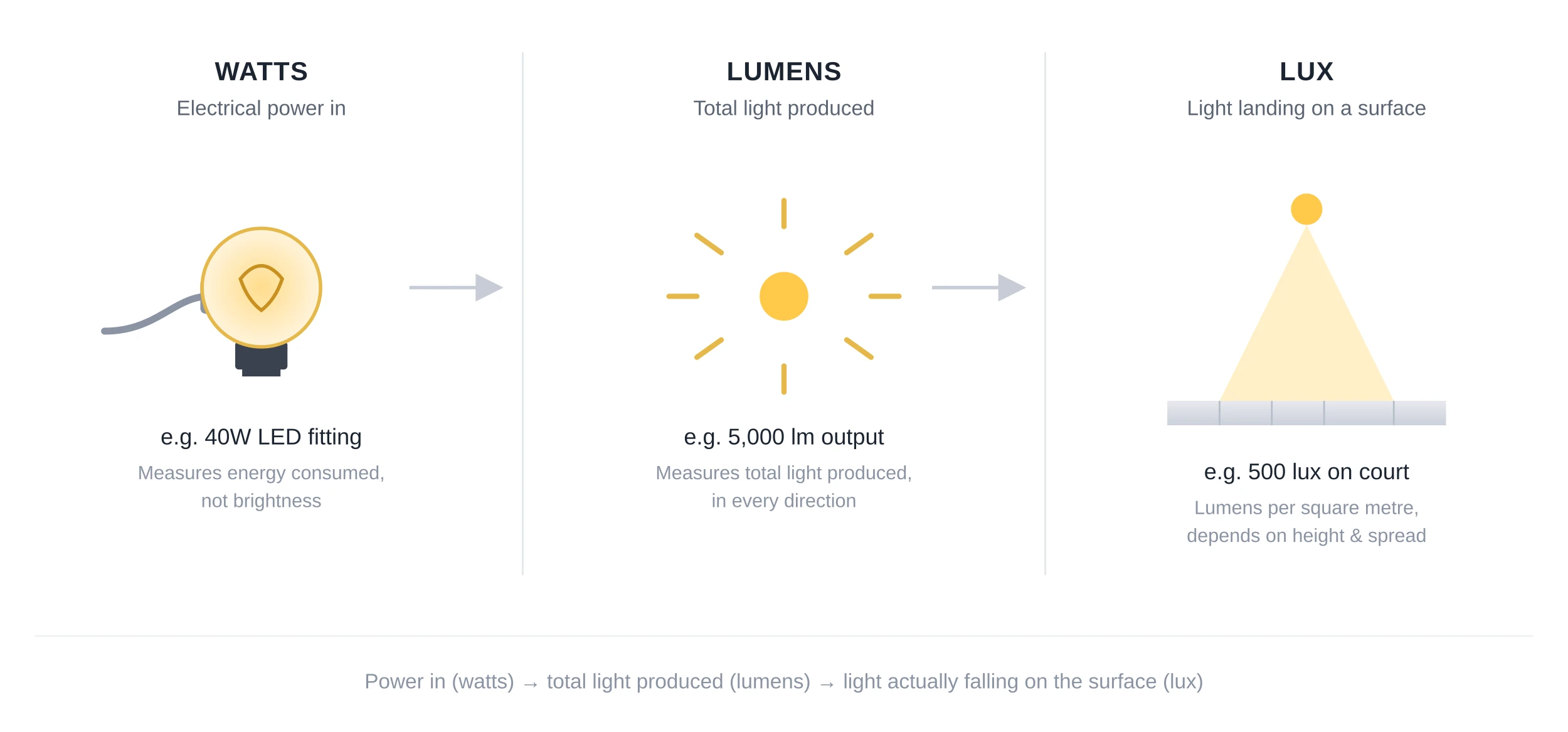
A watt (W) is a unit of electrical power. It measures how much energy a light fitting consumes, not how much light it produces.
With older lighting technology such as incandescent or fluorescent lamps, wattage was often used as a rough proxy for brightness, because those technologies were relatively similar in efficiency. A 100W incandescent bulb reliably produced more light than a 40W one.
LED technology has broken that link entirely. Modern LEDs produce significantly more light per watt than older technologies, which means comparing fittings by wattage alone can be misleading, and is one of the most common mistakes people make when upgrading old lighting, including the fluorescent tubes covered in our fluorescent tube phase-out guide.
A lumen (lm) measures the total quantity of visible light produced by a source, regardless of the direction it travels in. This is often referred to as luminous flux.
Lumens tell you how much light a fitting produces in total. A fitting rated at 5,000 lumens produces more total light output than one rated at 2,500 lumens, regardless of how much electrical power (watts) each one consumes.
Luminous efficacy, measured in lumens per watt (lm/W), describes how efficiently a fitting converts electrical power into visible light. This is the figure to compare when assessing the efficiency of different LED products, rather than wattage alone.
Lux (lx) measures how much light actually falls on a given surface. It is calculated as lumens per square metre.
This is the critical distinction: lumens describe the total light a fitting produces, while lux describes how much of that light lands on the surface you actually care about, such as a warehouse floor, an office desk or a tennis court.
The same fitting can produce very different lux readings depending on mounting height, distance from the surface, and the spread of its beam. This is why lighting design calculations, not simply lumen output on a spec sheet, are needed to determine whether a fitting will actually deliver the required light level for a space.
Because LED efficacy varies significantly between manufacturers and product ranges, two fittings with the same wattage can produce very different amounts of light. Relying on wattage to compare products, or to replace an old fitting on a like-for-like basis, can result in a space that is significantly under-lit.
This is particularly important for applications with a defined lighting requirement, such as:
In each case, the correct approach is to work backwards from the required lux level for the space, then select fittings, quantities and mounting positions capable of delivering it, rather than working forwards from a wattage figure alone.
At Nexis Lighting, every project starts with the lux requirement for the space, not the wattage of the fitting. Our team uses lighting design software to calculate how a proposed fitting, at a given mounting height and spacing, will perform against the required lux level and uniformity for the application.
This approach ensures a space is lit to the correct standard first, with energy efficiency and running costs then optimised within that requirement, rather than the other way around.
Watts measure the energy a fitting consumes, lumens measure the total light it produces, and lux measures how much of that light actually reaches the surface you need illuminated. Understanding the difference is the first step to specifying LED lighting correctly, whether you are replacing an old fluorescent installation or designing lighting for a new facility.
If you're unsure what lux level your space requires, or how a proposed fitting will actually perform once installed, our team can help.
For expert guidance or a free site survey, contact Nexis Lighting at sales@nexislighting.co.uk
Lumens measure the total amount of light a fitting produces, while lux measures how much of that light falls on a specific surface. A fitting's lumen output is fixed, but the lux it delivers depends on mounting height, distance and spread.
Not necessarily. With LED lighting, efficacy (lumens per watt) varies between products, so a higher wattage fitting does not always produce more light than a lower wattage one. Lumen output, not wattage, indicates total brightness.
Required lux levels vary by application and are often set by a governing body or standard, such as EN 12464-1 for workplaces or EN 12193 and the LTA for sports facilities. A lighting design calculation is the only reliable way to confirm a proposed installation will meet the required level.
Luminous efficacy, measured in lumens per watt (lm/W), describes how efficiently a fitting converts electrical power into visible light. It is a useful way to compare the efficiency of different LED products.
Yes. Our team can assess your site, calculate the lux levels and uniformity required for your application and recommend a lighting solution designed to meet that standard.
Book your free site survey today and discover how we can save you money, enhance your space and reduce your carbon footprint. Our experts will assess your needs and provide a tailored solution to brighten your space.