Tennis remains one of the UK's most widely played sports, from local park courts to private members clubs and professional training academies. As more venues extend their opening hours into the evening, well designed LED lighting has become essential for players to see the ball clearly, judge its speed and spin, and play safely and confidently after dark.
Poor lighting on a tennis court is more than an inconvenience, it can cause glare, uneven visibility, and increased risk of injury. With modern LED technology, clubs and facility operators can now deliver excellent light quality while reducing energy costs and ongoing maintenance.
In this guide, we'll cover the Lawn Tennis Association (LTA) lighting standards for outdoor floodlit courts, lux levels, and key considerations for lighting an outdoor tennis court, helping you plan an installation that performs well for players and budgets alike.
Outdoor tennis court lighting in the UK is governed by standards published by the Lawn Tennis Association (LTA), the sport's national governing body, specifically for outdoor floodlit courts. Rather than the generic Class I/II/III system used for some other racket sports, the LTA defines lighting requirements across two specific zones:
The LTA sets both a recommended level, for the best playing experience, and a minimum acceptable level for functional, compliant lighting.
Meeting these levels helps ensure players can track the ball clearly across the full length of the court, including overhead shots and serves, where lighting demands are typically highest and helps clubs seeking LTA accreditation or funding support meet the governing body's own facility requirements.
Tennis courts are long and narrow, which makes even light distribution more challenging than on many other sports surfaces. Meeting the LTA's uniformity ratio of 0.7 within the PPA helps eliminate dark patches at the baseline and net areas, where fast moving shots are hardest to track. The lower uniformity requirement across the wider TPA reflects the reduced but still important need for visibility in the run back and side zones.
Players frequently look upward when serving or returning lobs, which makes glare control especially important for tennis. Fittings with well controlled optics and correctly angled positioning reduce direct glare into players line of sight and help limit light spill towards neighbouring properties.
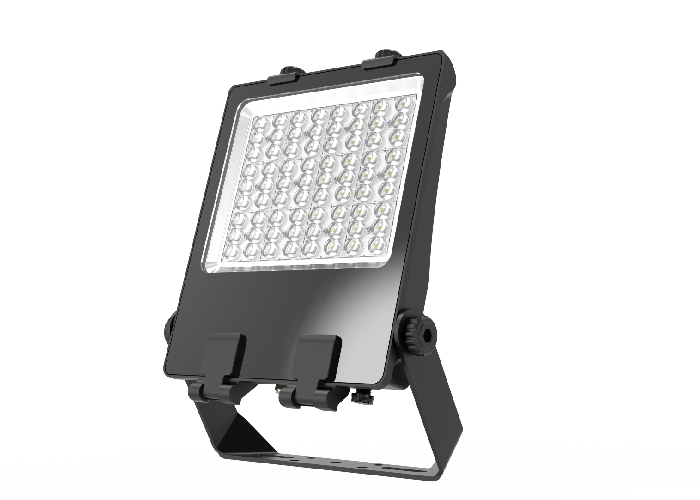
Outdoor tennis courts are typically lit from columns positioned along the sidelines rather than over the court itself, keeping light out of players direct eyeline during serves. Mounting height and column position are determined as part of a proper lighting design, based on the layout of the court, the number of courts being lit and the surrounding site.
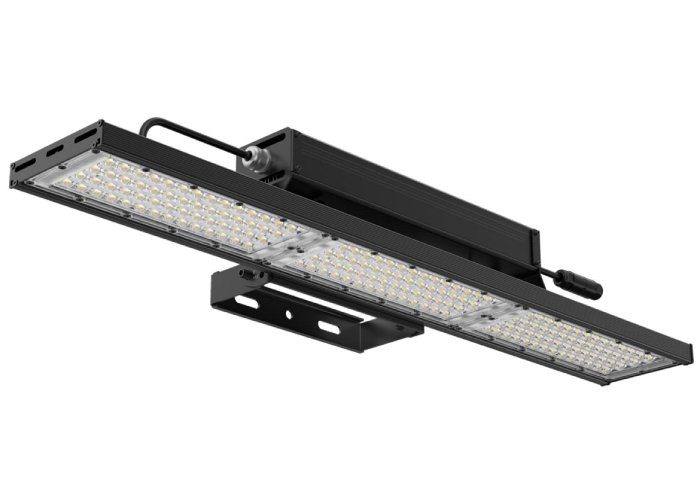
Outdoor tennis installations need weather-resistant fittings, typically IP65 or higher, to withstand rain and dust. Where fittings may be exposed to stray balls or general wear, an IK rating of IK08 or above is recommended for long-term durability.
A CRI of 80 or above ensures accurate visibility of the ball and court markings. Most outdoor tennis installations use a neutral to cool white colour temperature in the 4000–5000K range for clear, natural visibility for players and spectators.
Multi-court venues benefit from lighting that can be managed independently court by court. Bluetooth or booking-system integration allows lights to run only when a court is in use, helping reduce running costs across a facility with several courts operating on different schedules.
At Nexis Lighting, we treat outdoor tennis court lighting as a complete design exercise rather than simply a fitting selection. Using lighting design software, our engineers model each installation against the LTA's PPA and TPA requirements, accounting for court orientation, surrounding structures, and any shared use with other sports such as padel or pickleball.
Whether it's a single club court or a multi-court complex, we consider mounting position, aiming angles, and light spill into neighbouring areas or residential boundaries, a common planning consideration for outdoor tennis facilities, where formal planning consent is generally required.
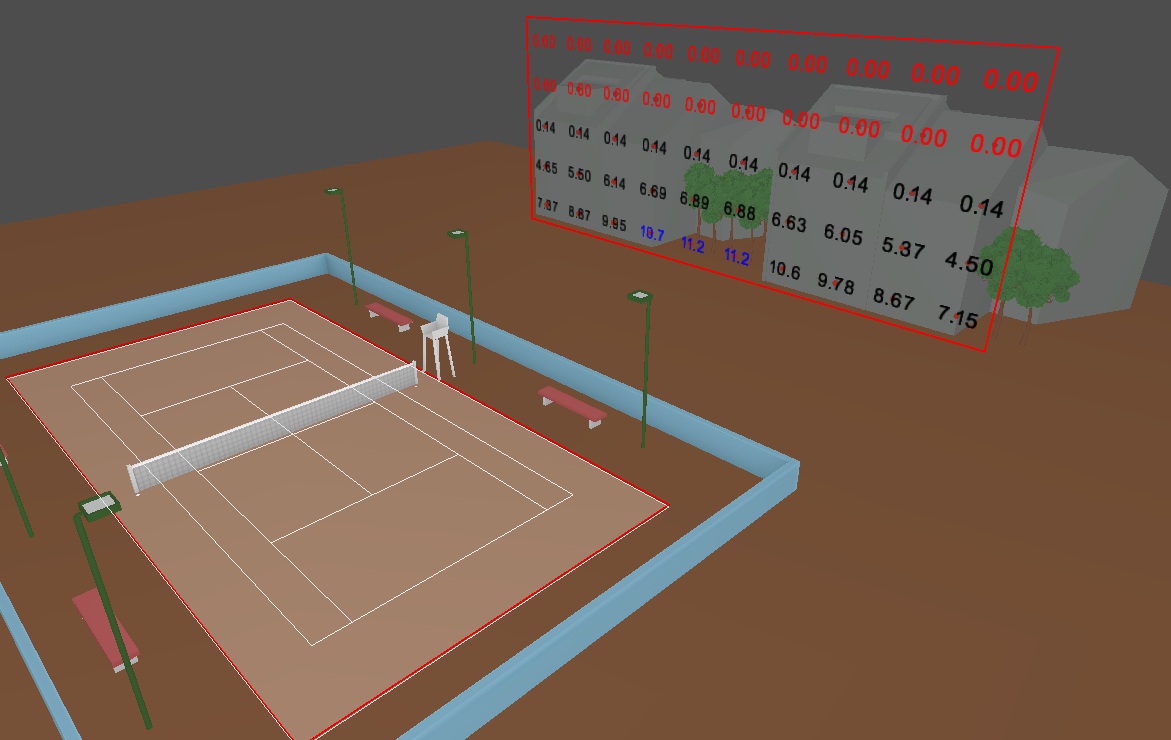
Good lighting design is central to a safe and enjoyable outdoor tennis court, whether for a weekly club session or a competitive match. High quality LED lighting improves visibility, reduces glare and keeps running costs down over the lifetime of the installation, while helping venues meet LTA lighting standards for accreditation and funding support.
Whether you're upgrading an existing court or lighting a new facility, our team can support you from initial site survey through to design, supply and installation.
For expert guidance or a free site survey, contact Nexis Lighting at sales@nexislighting.co.uk
The LTA recommends 500 lux in the Principal Playing Area (PPA) with a uniformity of 0.7, and 400 lux across the Total Playing Area (TPA) with a uniformity of 0.6. The minimum levels are 400 lux (PPA) and 300 lux (TPA).
The Principal Playing Area (PPA) is the area bounded by the outside of the doubles court lines. The Total Playing Area (TPA) includes the PPA plus the surrounding run-back and side-run zones, which require a slightly lower lux level and uniformity.
Outdoor fittings should have a minimum IP65 rating to resist rain and dust, along with an IK08 rating or above to withstand accidental impacts from balls or general wear.
Most outdoor tennis installations use a neutral to cool white colour temperature between 4000K and 5000K, providing clear natural visibility for players.
In many cases, yes. However, tennis courts are larger and follow the LTA's own PPA/TPA standard rather than the EN 12193 classes used for padel and pickleball, so lighting layouts should be designed specifically for each court type rather than assumed to transfer directly.
Book your free site survey today and discover how we can save you money, enhance your space and reduce your carbon footprint. Our experts will assess your needs and provide a tailored solution to brighten your space.